Skip to content

BeBOP: Circularity Work Package Successfully Completed – First Review Meeting Passed

The BeBOP project has successfully passed its first official Review Meeting (RP1) on 5 May 2026, marking a significant milestone for the consortium. ECODESIGN led Work Package 4, fully dedicated to circularity, and presented its results to the European Commission reviewers.

At the heart of the work is a novel seven-phase circularity framework tailored to emerging Power-and-Biomass-to-X (PBtX) processes at low-to-medium TRL: (1) mapping CE principles (narrow, slow, close, regenerate) onto process stages; (2) identifying and mobilizing relevant stakeholders; (3) gaining qualitative insights through targeted workshops; (4) translating these insights into quantitative circularity indicators; (5) evaluating circular business model opportunities; (6) systematically analyzing trade-offs and synergies between indicators; and (7) deriving actionable recommendations for scale-up. The framework was developed and validated across seven workshops with consortium partners and an external stakeholder network throughout 2025, resulting in 25 circularity indicators across four life cycle stages.
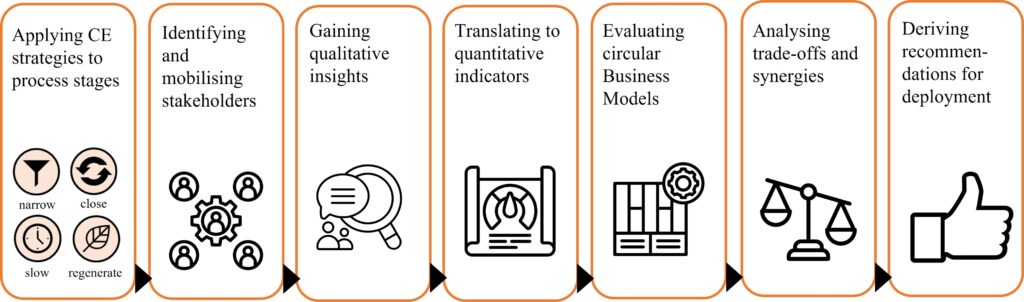
Key recommendations for the BeBOP scale-up include:

  • Designing for SOC longevity: The Solid Oxide Cell stack is the component with the highest cost, resource and efficiency impact over the plant’s operational life. Every design decision that extends its lifetime has a disproportionately large effect on both economics and circularity performance.
  • Building heat integration into the plant concept from the outset. Around 20 MW of surplus heat is expected to be available at 100 MW scale, offering an additional revenue stream and the potential to substitute not only fossil-based methanol but also fossil-based heat supply.
  • Choosing plant location strategically to maximize industrial symbiosis. Proximity to regional biomass sources, industrial heat consumers or district heating networks, and renewable electricity generation addresses resource efficiency from multiple angles.
  • Prioritizing feedstock quality as a system-wide circularity lever. Feedstock selection is the single most consequential upstream choice, as impurity and ash content affect gasification efficiency, plant uptime, and component lifetimes across all downstream process stages.
  • Adopting a service-oriented commercial model for initial deployments. Models in which the technology provider retains operational responsibility – such as performance-based revenue sharing or a leasing approach for the SOC – align incentives with circularity goals and enable material take-back at end of life.
  • ECODESIGN will share further details on the methodology and its applicability to PBtX projects at the e.nova 2026 International Conference, June 25, 2026, at the University of Applied Sciences Burgenland in Austria. The underlying project deliverables – including the methodological report (D4.1) and the validated circularity strategies (D4.2) – will be made publicly available (together with all other public project results) on the BeBOP Zenodo community upon the formal conclusion of the first reporting period in the upcoming weeks.

Weitere Neuigkeiten

BeBOP: Circularity Work Package Successfully Completed – First Review Meeting Passed

The BeBOP project has successfully passed its first official Review Meeting (RP1) on 5 May 2026, marking a significant milestone for the consortium. ECODESIGN led Work Package 4, fully dedicated to circularity, and presented its results to the European Commission reviewers. At the heart of the work is a novel seven-phase circularity framework tailored to … Continued

How is methanol produced from biomass and renewable electricity?

Good question, right? You’ll find the answer in this video! With the European innovation project BeBop, the sustainable transformation of the chemical industry is gaining further momentum. The aim of the project is the development and industrial implementation of a novel biomass-to-methanol plant that sets new standards through digital process optimization, high resource efficiency, and … Continued

Solid progress and poster presentation on the Social Life Cycle Assessment of SustaiNext

ECODESIGN presented its recent work on the Social Life Cycle Assessment (S-LCA) of the EU project SustaiNext, at the BioInnovation session of the BioCircular Summit held in Madrid last January 2026. The S-LCA methodology and the first phase results were successfully presented with a poster, available here. The S-LCA started with a comprehensive literature review … Continued

ECODESIGN Highlights Progress at the SustaiNext General Assembly

The SustaiNext project held its fifth General Assembly on 19–20 November 2025 in Turin, marking the midpoint of its work to develop sustainable processes for high-value botanical extracts in Extremadura, Spain. Across the consortium, progress is visible in plant construction, cultivation, biomass pre-treatment and early steps toward market applications. ECODESIGN’s Role ECODESIGN supports the project … Continued

18 February 2026 + 16 March 2026 // Two-Part Event on ECODESIGN: Strategies and Measures for Future-Proof Product Development

Together with Quality Austria, we are hosting a seminar led by Prof. Wolfgang Wimmer that explores how companies can design their products more efficiently, resource-consciously, and future-ready. The linear economic model is increasingly reaching its limits: raw materials are becoming scarcer, and emissions are subject to stricter regulations. With the new ESPR (Ecodesign Sustainable Product … Continued

First Year Consortium Meeting and Dissemination event of BeBOP in Milan (Italy), from 07 to 09 October 2025

In the context of the 1st year meeting of the European project BeBOP, the Italian partner Ente Italiano di Normazione – UNI hosted a dissemination event, attracting participants from research, academia, industry and motivated students who actively participate with their research posters. Read more about this event in the press release. Then the 1st Consortium … Continued

New ECODESIGN publication on the LCA of the EU project SUSTAINEXT

We are pleased to announce the publication of the paper “SUSTAINEXT: Validating a Zero-Waste, Dynamic, Multivalorization Route Biorefinery for Plant Extracts.” The study presents the Life Cycle Assessment (LCA) of botanical extract production, from feedstock sourcing to the final polyphenol-rich extracts, within the framework of the EU project SUSTAINEXT. The LCA results shows that: This … Continued

20 Years of ECODESIGN company GmbH!

In July 2025, we are celebrating 20 years of ECODESIGN company GmbH – two decades of innovation, collaboration, and commitment to a more sustainable future. Since 2005, we have been bringing ecodesign, circular economy, and sustainability from research into real-world application, supporting companies with: We sincerely thank our dedicated team, clients, and partners who made … Continued