
BeBOP: Circularity Work Package Successfully Completed – First Review Meeting Passed
The BeBOP project has successfully passed its first official Review Meeting (RP1) on 5 May 2026, marking a significant milestone for the consortium. ECODESIGN led Work Package 4, fully dedicated to circularity, and presented its results to the European Commission reviewers.
At the heart of the work is a novel seven-phase circularity framework tailored to emerging Power-and-Biomass-to-X (PBtX) processes at low-to-medium TRL: (1) mapping CE principles (narrow, slow, close, regenerate) onto process stages; (2) identifying and mobilizing relevant stakeholders; (3) gaining qualitative insights through targeted workshops; (4) translating these insights into quantitative circularity indicators; (5) evaluating circular business model opportunities; (6) systematically analyzing trade-offs and synergies between indicators; and (7) deriving actionable recommendations for scale-up. The framework was developed and validated across seven workshops with consortium partners and an external stakeholder network throughout 2025, resulting in 25 circularity indicators across four life cycle stages.
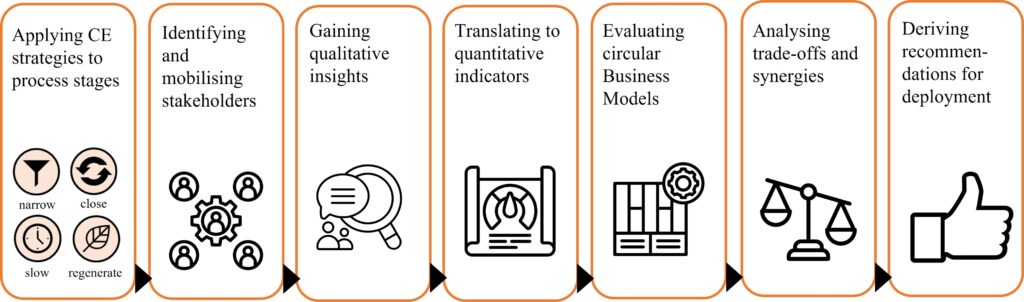
Key recommendations for the BeBOP scale-up include:
- Designing for SOC longevity: The Solid Oxide Cell stack is the component with the highest cost, resource and efficiency impact over the plant’s operational life. Every design decision that extends its lifetime has a disproportionately large effect on both economics and circularity performance.
- Building heat integration into the plant concept from the outset. Around 20 MW of surplus heat is expected to be available at 100 MW scale, offering an additional revenue stream and the potential to substitute not only fossil-based methanol but also fossil-based heat supply.
- Choosing plant location strategically to maximize industrial symbiosis. Proximity to regional biomass sources, industrial heat consumers or district heating networks, and renewable electricity generation addresses resource efficiency from multiple angles.
- Prioritizing feedstock quality as a system-wide circularity lever. Feedstock selection is the single most consequential upstream choice, as impurity and ash content affect gasification efficiency, plant uptime, and component lifetimes across all downstream process stages.
- Adopting a service-oriented commercial model for initial deployments. Models in which the technology provider retains operational responsibility – such as performance-based revenue sharing or a leasing approach for the SOC – align incentives with circularity goals and enable material take-back at end of life.
- ECODESIGN will share further details on the methodology and its applicability to PBtX projects at the e.nova 2026 International Conference, June 25, 2026, at the University of Applied Sciences Burgenland in Austria. The underlying project deliverables – including the methodological report (D4.1) and the validated circularity strategies (D4.2) – will be made publicly available (together with all other public project results) on the BeBOP Zenodo community upon the formal conclusion of the first reporting period in the upcoming weeks.